
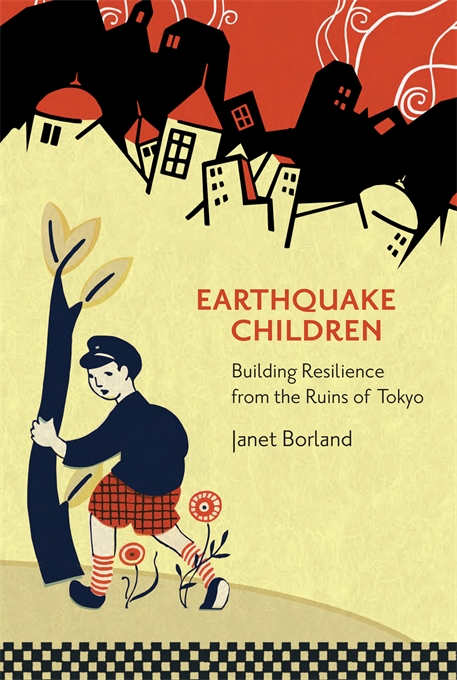
Janet Borland is the author of Earthquake Children: Building Resilience from the Ruins of Tokyo (Harvard University Asia Center, 2020). The Earthquake Children Image Archive contains over 500 images and serves as a companion to her book.
Japan, as recent history has powerfully illustrated, is one of the world’s most earthquake-prone countries. Today, it is also one of the best prepared and resilient nations to face such sizeable seismic risk. This was not always the case. Earthquake Children is the first book to examine the origins of modern Japan’s infrastructure of resilience. Drawing from a rich collection of previously unexplored sources, Janet Borland vividly illustrates that Japan’s contemporary culture of disaster preparedness and its people’s ability to respond calmly in a time of emergency are the result of learned and practiced behaviors. She traces their origins to the aftermath of the Great Kantō Earthquake, which killed over 100,000 people when it struck the Tokyo region in 1923.
Beyond providing new perspectives on Japan’s seismic past, the history of childhood, and everyday life in interwar Japan, this book challenges popular notions that Japanese people behave calmly whenever disaster strikes due to their innate qualities. Tokyo’s traumatic experiences in 1923 convinced government officials, seismologists, teachers, physicians, and architects that Japan must better prepare for future disasters. Earthquake Children documents how children, schools, and education became primary tools through which experts sought to build a disaster-prepared society and resilient nation.
AWARDS
Janet won the prestigious 2020 Grace Abbott Book Prize for the best book published in English on the history of children, childhood, or youth, and the Hong Kong Academy of the Humanities First Book Prize for 2020. Earthquake Children was also selected as one of three shortlisted books for Australia’s top history prize, the 2021 NSW Premier’s History Awards, General History Prize, and the Australian Historical Association’s 2022 W.K. Hancock Prize.
PRAISE FOR EARTHQUAKE CHILDREN
“Earthquake Children is essential reading for historians of childhood and of disaster, but it has much to inform other histories as well. Women and men (and other adults somewhere in between) are not the only movers and shakers of scientific advances, technological innovations, and social change; generation and childhood contribute as well, and we should consider them much more often.”

Sabine Frühstück, Contemporary Japan
“Borland’s work is as intellectually rigorous as it is inspiring. Earthquake Children is the first scholarly work to center children’s experiences in the Great Kantō Earthquake and to identify how they became integral to Japan’s cultural turn toward resilience… Earthquake Children is highly readable and will be of interest to a broad range of academics in the humanities, social sciences, geophysical sciences, and engineering... I absolutely loved this book and have continued to think about it long after I finished reading the last page. It stands as an unforgettable reminder of how important it is to listen to what children have to say and to invest in their futures.”

Lori Peek, International Journal of Mass Emergencies and Disasters
“An absorbing book…Narrates the vivid and emotional stories of how children experienced and made sense of the earthquake, how teachers and other adults interpreted the children’s experience, and the subsequent initiatives to develop disaster-preparedness in the public…Succeeds in illuminating the contemporary relevance of this historical study.”

Kaori H. Okano, Journal of Japanese Studies
“[Borland’s] research is thorough, her writing is often vivid, and the book is very well illustrated. Whether using her own words or those of Japan’s children, the author is able to convey a vivid sense of the horror of an event like the Great Kanto Earthquake and the difficulties faced by many survivors…Earthquake Children will appeal to anyone interested in social responses to earthquakes and other disasters in urban areas, to those interested in the history of children, and to anyone interested in the modern history of Tokyo.”

Gregory Smits, Monumenta Nipponica
“This fascinating and well-researched volume makes a clear case for the important roles played by children and those thinking about children in the aftermath of the Great Kantō Earthquake. Children were symbols of vulnerability, resilience, and hope, and they were also vessels through which the lessons learned in the quake could be mobilized for future disasters. This book will be a worthwhile addition to libraries and useful for scholars of disasters and childhood.”

Alex Bates, Pacific Affairs
"By mining a remarkable archive of materials generated before and after the earthquake, Borland demonstrates that children played a critical role in the development of Japan’s distinctive approach to disaster-preparedness…The book’s graceful narrative rendered in clear and accessible prose, along with its helpful methodological discussions, will make it valuable to scholars and students in many fields.”

2020 Grace Abbott Book Prize, Society for the History of Children and Youth
“Earthquake Children [is] an outstanding work of archival discovery, impeccably researched and striking a fine balance between academic and popular history. Its thesis is clearly articulated and well defended. The book painstakingly assembles a mountain of material to show that the legendary preparedness of Japanese society did not come naturally, but began with policies implemented after the horrors inflicted by the Great Kantō Earthquake of 1923.”

2020 Hong Kong Academy of the Humanities First Book Prize
“Janet Borland’s Earthquake Children is an archivally rich study of Tokyo’s catastrophic earthquake of 1923. Borland’s lucidly written and accessible work draws on extensive textual and image-based research in Japanese history. This fascinating case study offers many insights for both generalist and specialist readers by seamlessly combining the fields of children’s history, disaster studies, and infrastructure development.

2021 NSW Premier’s History Awards, General History Prize, Shortlist
“This innovative, compelling, and often moving story of Japan’s Great Earthquake of 1923 is more than a major contribution to the history of childhood. Told largely told through the eyes of the children who experienced the disaster, Janet Borland draws on a rich collection of primary materials, including children’s drawings and essays, to provide original insights into the ways in which children were used in post-earthquake Japan.”

2022 W. K. Hancock Prize, Australian Historical Association, Shortlist
 Janet Borland